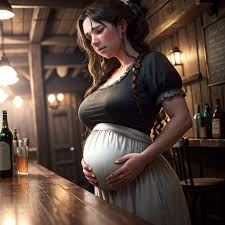
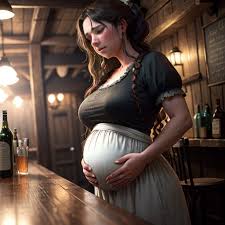
Perhaps it was news of the child. Perhaps she wished for death. Sometimes women did that. He had no children, and in the days of his youth, while being shaped by the Dark, if any woman had told him that she was carrying his seed, he’d have killed her on the spot.
Now, he said, “If you do not rid yourself of this child, bring it to me after it is born, and I will give you a new name. But remember, I will take only what you give.”
At that, her expression changed. She knew the meaning of a ‘new name’. Everyone in this blighted country prayed for one. A new name was given to those chosen by the Dark. She’d be protected, rich, have powers.
“I will give all, Mi’Lord.” And only then had she lowered her head.
She didn’t see him during the months of her pregnancy, yet she’d been given care. She was taken to the kitchen immediately and given a drink that soothed her aching limbs, then offered a warm corner near the hearth in a land that was always chill. She had two wool dresses now, dyed blue with woad, and they didn’t drag the ground. No one hit her. She was regularly fed. And so, she worked in the kitchen, chopping and peeling, carrying platters, baking bread. In the early months, she seldom thought about her condition.
When the child began to move, kicking and turning, she forced herself to remember the promise of a new name — lest she take a long needle and force it out.
The rest of the staff regarded her as royalty, especially when she was moved from the corner and to a room of her own. In the room was a bed with feather tick and a rug on the floor, and she did feel royal. But she worked harder, her belly often straining against a too heavy tray or bumping against the edges of tables. She didn’t want friends, but she didn’t want enemies, either. The latter was saying a lot in this cold land where it was easy to hate. Where bodies were gathered onto a cart daily, and taken to Carrion Hill, where the crows were fat and patient.
When the baby came, a healthy boy with black eyes and jet hair, she’d gone to the Tu’el as soon as she was able. To say that she hated the baby was an understatement. Every time she looked at him, she looked for traces of the one who’d made him. When he cried, she saw the ruddy faced encourager who’d urged them on, and the swarthy man who’d held a knife against her throat throughout, and smelled the next, whose blood encrusted hands had touched her everywhere. She saw them all in the face of her babe, but nothing of herself. Nor of the fourth man, for when he entered her, she’d blacked out.

